A spondee (Latin: spondeus) is a metrical foot consisting of two long syllables, as determined by syllable weight in classical meters, or two stressed syllables in modern meters.[1] The word comes from the Greek σπονδή, spondḗ, 'libation'.
https://en.wikipedia.org/wiki/Spondee
A libation is a ritual pouring of a liquid, or grains such as rice, as an offering to a deity or spirit, or in memory of the dead. It was common in many religions of antiquity and continues to be offered in cultures today.
Various substances have been used for libations, most commonly wine or other alcoholic drinks, olive oil, honey, and in India, ghee. The vessels used in the ritual, including the patera, often had a significant form which differentiated them from secular vessels. The libation could be poured onto something of religious significance, such as an altar, or into the earth.
In East Asia, pouring an offering of rice into a running stream symbolizes the detachment from karma and bad energy.
https://en.wikipedia.org/wiki/Libation
And Jacob set up a Pillar in the place where he had spoken with him, a Pillar of Stone; and he poured out a drink offering on it, and poured oil on it.
— Genesis 35:14
https://en.wikipedia.org/wiki/Libation
Canaan (/ˈkeɪnən/; Phoenician: 𐤊𐤍𐤏𐤍 – KNʿN;[1] Hebrew: כְּנַעַן – Kənáʿan, in pausa כְּנָעַן – Kənāʿan; Biblical Greek: Χανααν – Khanaan;[2] Arabic: كَنْعَانُ – Kan‘ān) was a Semitic-speaking civilization and region of the Southern Levant in the Ancient Near East during the late 2nd millennium BC. Canaan had significant geopolitical importance in the Late Bronze Age Amarna Period (14th century BC) as the area where the spheres of interest of the Egyptian, Hittite, Mitanni and Assyrian Empires converged or overlapped. Much of present-day knowledge about Canaan stems from archaeological excavation in this area at sites such as Tel Hazor, Tel Megiddo, En Esur, and Gezer.
https://en.wikipedia.org/wiki/Canaan
Nomadic pastoralism is a form of pastoralism in which livestock are herded in order to seek for fresh pastures on which to graze. True nomads follow an irregular pattern of movement, in contrast with transhumance, where seasonal pastures are fixed.[1] However, this distinction is often not observed and the term 'nomad' used for both—and in historical cases the regularity of movements is often unknown in any case. The herded livestock include cattle, water buffalo, yaks, llamas, sheep, goats, reindeer, horses, donkeys or camels, or mixtures of species. Nomadic pastoralism is commonly practised in regions with little arable land, typically in the developing world, especially in the steppe lands north of the agricultural zone of Eurasia.[2]
Of the estimated 30–40 million nomadic pastoralists worldwide, most are found in central Asia and the Sahel region of North and West Africa, such as Fulani, Tuaregs, and Toubou, with some also in the Middle East, such as traditionally Bedouins, and in other parts of Africa, such as Nigeria and Somalia. Increasing numbers of stock may lead to overgrazing of the area and desertification if lands are not allowed to fully recover between one grazing period and the next. Increased enclosure and fencing of land has reduced the amount of land for this practice.
There is substantive uncertainty over the extent to which the various causes for degradation affect grassland. Different causes have been identified which include overgrazing, mining, agricultural reclamation, pests and rodents, soil properties, tectonic activity, and climate change.[3] Simultaneously, it is maintained that some, such as overgrazing and overstocking, may be overstated while others, such as climate change, mining and agricultural reclamation, may be under reported. In this context, there is also uncertainty as to the long-term effect of human behavior on the grassland as compared to non-biotic factors.[4]
https://en.wikipedia.org/wiki/Nomadic_pastoralism
In archaeology, the Epipalaeolithic or Epipaleolithic (sometimes Epi-paleolithic etc.) is a period occurring between the Upper Paleolithic and Neolithic during the Stone Age. Mesolithic also falls between these two periods, and the two are sometimes confused or used as synonyms. More often, they are distinct, referring to approximately the same period of time in different geographic areas. Epipaleolithic always includes this period in the Levant and, often, the rest of the Near East. It sometimes includes parts of Southeast Europe, where Mesolithic is much more commonly used. Mesolithic very rarely includes the Levant or the Near East; in Europe, Epipalaeolithic is used, though not very often, to refer to the early Mesolithic.
https://en.wikipedia.org/wiki/Epipalaeolithic
A millennium (plural millennia or millenniums) is a period of one thousand years,[1] sometimes called a kiloannum (ka), or kiloyear (ky). Normally, the word is used specifically for periods of a thousand years that begin at the starting point (initial reference point) of the calendar in consideration (typically the year "1") and at later years that are whole number multiples of a thousand years after the start point. The term can also refer to an interval of time beginning on any date. Millennia sometimes have religious or theological implications (see millenarianism).
The word millennium derives from the Latin mille, thousand, and annus, year.[2]
https://en.wikipedia.org/wiki/Millennium
A century is a period of 100 years. Centuries are numbered ordinally in English and many other languages. The word century comes from the Latin centum, meaning one hundred. Century is sometimes abbreviated as c.[1]
A centennial or centenary is a hundredth anniversary, or a celebration of this, typically the remembrance of an event which took place a hundred years earlier.
A century from now will be 19:49, 6 May 2123.
https://en.wikipedia.org/wiki/Century
Start and end of centuries
Although a century can mean any arbitrary period of 100 years, there are two viewpoints on the nature of standard centuries. One is based on strict construction, while the other is based on popular perception.
According to the strict construction, the 1st century AD began with AD 1 and ended with AD 100, the 2nd century spanning the years 101 to 200, with the same pattern continuing onward.[note 1] In this model, the n-th century starts with the year that ends with "01", and ends with the year that ends with "00"; for example, the 20th century comprises the years 1901 to 2000 in strict usage.[2]
In popular perception and practice, centuries are structured by grouping years based on sharing the 'hundreds' digit(s). In this model, the n-th century starts with the year that ends in "00" and ends with the year ending in "99";[3] for example, the years 1900 to 1999, in popular culture, constitute the 20th century.[4] (This is similar to the grouping of "0-to-9 decades" which share the 'tens' digit.)
To facilitate calendrical calculations by computer, the astronomical year numbering and ISO 8601 systems both contain a year zero, with the astronomical year 0 corresponding to the year 1 BCE, the astronomical year -1 corresponding to 2 BCE, and so on.[5][6]
https://en.wikipedia.org/wiki/Century
A decade (from Ancient Greek δεκάς (dekas) 'a group of ten') is a period of ten years. Decades may describe any ten-year period, such as those of a person's life, or refer to specific groupings of calendar years.
https://en.wikipedia.org/wiki/Decade
https://en.wikipedia.org/wiki/Century
In physics and the philosophy of science, instant refers to an infinitesimal interval in time, whose passage is instantaneous. In ordinary speech, an instant has been defined as "a point or very short space of time," a notion deriving from its etymological source, the Latin verb instare, from in- + stare ('to stand'), meaning 'to stand upon or near.'[1]
The continuous nature of time and its infinite divisibility was addressed by Aristotle in his Physics, where he wrote on Zeno's paradoxes. The philosopher and mathematician Bertrand Russell was still seeking to define the exact nature of an instant thousands of years later.[2]
As of October 2020, the smallest time interval certify in regulated measurements is on the order of 397 zeptoseconds (397 × 10−21 seconds).[3]
https://en.wikipedia.org/wiki/Instant
In mathematics, an infinitesimal number is a quantity that is closer to zero than any standard real number, but that is not zero. The word infinitesimal comes from a 17th-century Modern Latin coinage infinitesimus, which originally referred to the "infinity-th" item in a sequence.
https://en.wikipedia.org/wiki/Infinitesimal
In mathematics, the system of hyperreal numbers is a way of treating infinite and infinitesimal (infinitely small but non-zero) quantities. The hyperreals, or nonstandard reals, *R, are an extension of the real numbers R that contains numbers greater than anything of the form
- (for any finite number of terms).

Such numbers are infinite, and their reciprocals are infinitesimals. The term "hyper-real" was introduced by Edwin Hewitt in 1948.[1]
The hyperreal numbers satisfy the transfer principle, a rigorous version of Leibniz's heuristic law of continuity. The transfer principle states that true first-order statements about R are also valid in *R. For example, the commutative law of addition, x + y = y + x, holds for the hyperreals just as it does for the reals; since R is a real closed field, so is *R. Since for all integers n, one also has for all hyperintegers . The transfer principle for ultrapowers is a consequence of Łoś's theorem of 1955.


Concerns about the soundness of arguments involving infinitesimals date back to ancient Greek mathematics, with Archimedes replacing such proofs with ones using other techniques such as the method of exhaustion.[2] In the 1960s, Abraham Robinson proved that the hyperreals were logically consistent if and only if the reals were. This put to rest the fear that any proof involving infinitesimals might be unsound, provided that they were manipulated according to the logical rules that Robinson delineated.
The application of hyperreal numbers and in particular the transfer principle to problems of analysis is called nonstandard analysis. One immediate application is the definition of the basic concepts of analysis such as the derivative and integral in a direct fashion, without passing via logical complications of multiple quantifiers. Thus, the derivative of f(x) becomes for an infinitesimal , where st(·) denotes the standard part function, which "rounds off" each finite hyperreal to the nearest real. Similarly, the integral is defined as the standard part of a suitable infinite sum.


The transfer principle
The idea of the hyperreal system is to extend the real numbers R to form a system *R that includes infinitesimal and infinite numbers, but without changing any of the elementary axioms of algebra. Any statement of the form "for any number x..." that is true for the reals is also true for the hyperreals. For example, the axiom that states "for any number x, x + 0 = x" still applies. The same is true for quantification over several numbers, e.g., "for any numbers x and y, xy = yx." This ability to carry over statements from the reals to the hyperreals is called the transfer principle. However, statements of the form "for any set of numbers S ..." may not carry over. The only properties that differ between the reals and the hyperreals are those that rely on quantification over sets, or other higher-level structures such as functions and relations, which are typically constructed out of sets. Each real set, function, and relation has its natural hyperreal extension, satisfying the same first-order properties. The kinds of logical sentences that obey this restriction on quantification are referred to as statements in first-order logic.
The transfer principle, however, does not mean that R and *R have identical behavior. For instance, in *R there exists an element ω such that

but there is no such number in R. (In other words, *R is not Archimedean.) This is possible because the nonexistence of ω cannot be expressed as a first-order statement.
Use in analysis
Informal notations for non-real quantities have historically appeared in calculus in two contexts: as infinitesimals, like dx, and as the symbol ∞, used, for example, in limits of integration of improper integrals.
As an example of the transfer principle, the statement that for any nonzero number x, 2x ≠ x, is true for the real numbers, and it is in the form required by the transfer principle, so it is also true for the hyperreal numbers. This shows that it is not possible to use a generic symbol such as ∞ for all the infinite quantities in the hyperreal system; infinite quantities differ in magnitude from other infinite quantities, and infinitesimals from other infinitesimals.
Similarly, the casual use of 1/0 = ∞ is invalid, since the transfer principle applies to the statement that zero has no multiplicative inverse. The rigorous counterpart of such a calculation would be that if ε is a non-zero infinitesimal, then 1/ε is infinite.
For any finite hyperreal number x, the standard part, st(x), is defined as the unique closest real number to x; it necessarily differs from x only infinitesimally. The standard part function can also be defined for infinite hyperreal numbers as follows: If x is a positive infinite hyperreal number, set st(x) to be the extended real number , and likewise, if x is a negative infinite hyperreal number, set st(x) to be (the idea is that an infinite hyperreal number should be smaller than the "true" absolute infinity but closer to it than any real number is).


Differentiation
One of the key uses of the hyperreal number system is to give a precise meaning to the differential operator d as used by Leibniz to define the derivative and the integral.
For any real-valued function the differential is defined as a map which sends every ordered pair (where is real and is nonzero infinitesimal) to an infinitesimal



Note that the vary notation "" used to denote any infinitesimal is consistent with the above definition of the operator for if one interprets (as is commonly done) to be the function then for every the differential will equal the infinitesimal .


A real-valued function is said to be differentiable at a point if the quotient


is the same for all nonzero infinitesimals If so, this quotient is called the derivative of at .

For example, to find the derivative of the function , let be a non-zero infinitesimal. Then,


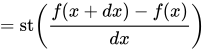
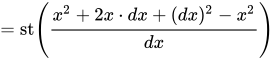
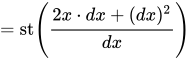


The use of the standard part in the definition of the derivative is a rigorous alternative to the traditional practice of neglecting the square[citation needed] of an infinitesimal quantity. Dual numbers are a number system based on this idea. After the third line of the differentiation above, the typical method from Newton through the 19th century would have been simply to discard the dx2 term. In the hyperreal system, dx2 ≠ 0, since dx is nonzero, and the transfer principle can be applied to the statement that the square of any nonzero number is nonzero. However, the quantity dx2 is infinitesimally small compared to dx; that is, the hyperreal system contains a hierarchy of infinitesimal quantities.
Integration
Another key use of the hyperreal number system is to give a precise meaning to the integral sign ∫ used by Leibniz to define the definite integral.
For any infinitesimal functionone may define the integral as a map sending any ordered triple (whereandare real, andis infinitesimal of the same sign as ) to the value


whereis any hyperinteger number satisfying


A real-valued function is then said to integrable over a closed intervalif for any nonzero infinitesimalthe integral
![{\displaystyle \ [a,b]\ }](https://wikimedia.org/api/rest_v1/media/math/render/svg/83df277421318a0849b4079159ed239e78c7554c)

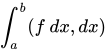
is independent of the choice of If so, this integral is called the definite integral (or antiderivative) of on

![{\displaystyle \ [a,b].}](https://wikimedia.org/api/rest_v1/media/math/render/svg/81bd7262d14418fb9c81b9e05562bb90884bf438)
This shows that using hyperreal numbers, Leibniz's notation for the definite integral can actually be interpreted as a meaningful algebraic expression (just as the derivative can be interpreted as a meaningful quotient).[3]
Properties
The hyperreals *R form an ordered field containing the reals R as a subfield. Unlike the reals, the hyperreals do not form a standard metric space, but by virtue of their order they carry an order topology.
The use of the definite article the in the phrase the hyperreal numbers is somewhat misleading in that there is not a unique ordered field that is referred to in most treatments. However, a 2003 paper by Vladimir Kanovei and Saharon Shelah[4] shows that there is a definable, countably saturated (meaning ω-saturated, but not, of course, countable) elementary extension of the reals, which therefore has a good claim to the title of the hyperreal numbers. Furthermore, the field obtained by the ultrapower construction from the space of all real sequences, is unique up to isomorphism if one assumes the continuum hypothesis.
The condition of being a hyperreal field is a stronger one than that of being a real closed field strictly containing R. It is also stronger than that of being a superreal field in the sense of Dales and Woodin.[5]
Development
The hyperreals can be developed either axiomatically or by more constructively oriented methods. The essence of the axiomatic approach is to assert (1) the existence of at least one infinitesimal number, and (2) the validity of the transfer principle. In the following subsection we give a detailed outline of a more constructive approach. This method allows one to construct the hyperreals if given a set-theoretic object called an ultrafilter, but the ultrafilter itself cannot be explicitly constructed.https://en.wikipedia.org/wiki/Hyperreal_number
A timekeeper is an instrument or person that measures the passage of time.
https://en.wikipedia.org/wiki/Timekeeper
Horology (lit. 'the study of time'; related to Latin horologium; from Ancient Greek ὡρολόγιον (hōrológion) 'instrument for telling the hour'; from ὥρα (hṓra) 'hour, time', interfix -o-, and suffix -logy)[1][2] is the study of the measurement of time. Clocks, watches, clockwork, sundials, hourglasses, clepsydras, timers, time recorders, marine chronometers, and atomic clocks are all examples of instruments used to measure time. In current usage, horology refers mainly to the study of mechanical time-keeping devices, while chronometry more broadly includes electronic devices that have largely supplanted mechanical clocks for the best accuracy and precision in time-keeping.
https://en.wikipedia.org/wiki/Horology
An atomic clock is a clock that measures time by monitoring the resonant frequency of atoms. It is based on atoms having different energy levels. Electron states in an atom are associated with different energy levels, and in transitions between such states they interact with a very specific frequency of electromagnetic radiation. This phenomenon serves as the basis for the International System of Units' (SI) definition of a second:
The second, symbol s, is the SI unit of time. It is defined by taking the fixed numerical value of the caesium frequency, , the unperturbed ground-state hyperfine transition frequency of the caesium 133 atom, to be 9192631770 when expressed in the unit Hz, which is equal to s−1.

This definition is the basis for the system of International Atomic Time (TAI), which is maintained by an ensemble of atomic clocks around the world. The system of Coordinated Universal Time (UTC) that is the basis of civil time implements leap seconds to allow clock time to track changes in Earth's rotation to within one second while being based on clocks that are based on the definition of the second.
The accurate timekeeping capabilities of atomic clocks are also used for navigation by satellite networks such as the European Union's Galileo Program and the United States' GPS. The timekeeping accuracy of the involved atomic clocks is important because the smaller the error in time measurement, the smaller the error in distance obtained by multiplying the time by the speed of light is (a timing error of a nanosecond or 1 billionth of a second (10−9 or 1⁄1,000,000,000 second) translates into an almost 30-centimetre (11.8 in) distance and hence positional error).
The main variety of atomic clock uses caesium atoms cooled to temperatures that approach absolute zero. The primary standard for the United States, the National Institute of Standards and Technology (NIST)'s caesium fountain clock named NIST-F2, measures time with an uncertainty of 1 second in 300 million years (relative uncertainty 10−16). NIST-F2 was brought online on 3 April 2014.[2][3]
https://en.wikipedia.org/wiki/Atomic_clock

https://en.wikipedia.org/wiki/Century
During the 1930s, Isidor Rabi built equipment for atomic beam magnetic resonance frequency clocks.[7][8]
https://en.wikipedia.org/wiki/Atomic_clock
Before the demonstration of the frequency comb in 2000, terahertz techniques were needed to bridge the gap between radio and optical frequencies, and the systems for doing so were cumbersome and complicated. With the refinement of the frequency comb, these measurements have become much more accessible and numerous optical clock systems are now being developed around the world.[113]
https://en.wikipedia.org/wiki/Atomic_clock
The most accurate caesium clocks based on the caesium frequency of 9.19 GHz have an accuracy between 10−15–10−16. Unfortunately, they are big and only available in large metrology labs and not useful for factories or industrial environments that would use an atomic clock for GPS accuracy but can't afford to build a whole metrology laboratory for one atomic clock. Researchers have designed a strontium optical clock that can be moved around in an air-conditioned car trailer.[153]
https://en.wikipedia.org/wiki/Atomic_clock
A radio clock is a clock that automatically synchronizes itself by means of radio time signals received by a radio receiver. Some manufacturers may label radio clocks as atomic clocks,[195] because the radio signals they receive originate from atomic clocks. Normal low-cost consumer-grade receivers that rely on the amplitude-modulated time signals have a practical accuracy uncertainty of ± 0.1 second. This is sufficient for many consumer applications.[195] Instrument grade time receivers provide higher accuracy. Radio clocks incur a propagation delay of approximately 1 ms for every 300 kilometres (186 mi) of distance from the radio transmitter. Many governments operate transmitters for timekeeping purposes.[196]
https://en.wikipedia.org/wiki/Atomic_clock
See also
Explanatory notes
- Researchers at the University of Wisconsin-Madison have demonstrated a clock that will not lose a second in 300 billion years.[60]

https://en.wikipedia.org/wiki/Atomic_clock
A speaking clock or talking clock is a live or recorded human voice service, usually accessed by telephone, that gives the correct time. The first telephone speaking clock service was introduced in France, in association with the Paris Observatory, on 14 February 1933.[1]
The format of the service is similar to that of radio time signal services. At set intervals (e.g. ten seconds) a voice announces (for example) "At the third stroke, the time will be twelve forty-six and ten seconds……", with three beeps following. Some countries have sponsored time announcements and include the sponsor's name in the message.
https://en.wikipedia.org/wiki/Speaking_clock
In 1934, electronic engineer and inventor F.H. Leeuwrik built a speaking clock for the municipal telephone service of The Hague using optically recorded speech, looping on a large drum. The female voice was provided by the then 24-year-old school teacher Cor Hoogendam, hence the machine was nicknamed Tante Cor (Aunt Cor).[23]
https://en.wikipedia.org/wiki/Speaking_clock
In 1935, Soviet Central Scientific Research Institute of Communications received a government order to design the "Speaking Clock" for Moscow City Telephone Network.[29][30] "Speaking Clock" was constructed based on cinematic techniques[30] and consists of discs with pulse-density modulation optical marks on photographic tapes, photocell with actuator, and audio tube amplifier.[31] On May 14, 1937 "speaking clock" connected to Moscow City Telephone Network for test operation and it was reachable on the numbers Russian: "Г 1-98-48" and Russian: "Г 1-98-49".[29][30][31] It was speaking with the recorded voice of Soviet actor and broadcaster Emmanuil Tobiash.[29][30][31] In 1937, the first cities to be equipped with this devices were Moscow and Leningrad.[32]
https://en.wikipedia.org/wiki/Speaking_clock
The speaking clock in Sweden is run by Telia and can be reached by calling 90 510 from landline phones or 08-90 510 from mobile phones. The service is called Fröken Ur which means Miss Clock. It has been in use since 1934. Various voices have stated the time. Since 2000 the voice which states the time belongs to Johanna Hermann Lundberg. In 1977 the speaking clock in Sweden received 64 000 000 calls - which is the record for a year. In 2020 the number of calls was about 2 000 per day, meaning a total of a bit less than 1 000 000 calls annually.[citation needed]
https://en.wikipedia.org/wiki/Speaking_clock
https://en.wikipedia.org/wiki/General_Conference_on_Weights_and_Measures#International_Committee_for_Weights_and_Measures
https://en.wikipedia.org/wiki/Internet
https://en.wikipedia.org/wiki/Time_signal
https://en.wikipedia.org/wiki/Radio_astronomy
https://en.wikipedia.org/wiki/Russian_Aerospace_Defence_Forces
https://en.wikipedia.org/wiki/China_National_Space_Administration
https://en.wikipedia.org/wiki/Deep_Space_Atomic_Clock
https://en.wikipedia.org/wiki/Phase_noise
https://en.wikipedia.org/wiki/Bandwidth_(signal_processing)
https://en.wikipedia.org/wiki/Magneto-optical_trap
https://en.wikipedia.org/wiki/Gravitational_time_dilation
https://en.wikipedia.org/wiki/Fermi_gas
https://en.wikipedia.org/wiki/Degenerate_matter
https://en.wikipedia.org/wiki/Coordinated_Universal_Time
https://en.wikipedia.org/wiki/Earth%27s_rotation
https://en.wikipedia.org/wiki/Leap_second
https://en.wikipedia.org/wiki/Speed_of_light
https://en.wikipedia.org/wiki/Measurement_uncertainty
https://en.wikipedia.org/wiki/Optical_pumping
https://en.wikipedia.org/wiki/Empirical_evidence
https://en.wikipedia.org/wiki/William_Thomson,_1st_Baron_Kelvin
https://en.wikipedia.org/wiki/Quartz_clock
https://en.wikipedia.org/wiki/Shortt%E2%80%93Synchronome_clock
https://en.wikipedia.org/wiki/Radio_clock
https://en.wikipedia.org/wiki/Atomichron
https://en.wikipedia.org/wiki/2019_redefinition_of_the_SI_base_units
https://en.wikipedia.org/wiki/Frequency_comb
https://en.wikipedia.org/wiki/Chip-scale_atomic_clock
https://en.wikipedia.org/wiki/Ion_trap
https://en.wikipedia.org/wiki/Microwave
https://en.wikipedia.org/wiki/Proper_time
https://en.wikipedia.org/wiki/Gravitational_field
https://en.wikipedia.org/wiki/All-Russian_Scientific_Research_Institute_for_Physical-Engineering_and_Radiotechnical_Metrology
https://en.wikipedia.org/wiki/International_Bureau_of_Weights_and_Measures
https://en.wikipedia.org/wiki/Calibration
https://en.wikipedia.org/wiki/GLONASS
https://en.wikipedia.org/wiki/Fiber-optic_cable
https://en.wikipedia.org/wiki/Geoid
https://en.wikipedia.org/wiki/Caesium_standard
https://en.wikipedia.org/wiki/Voltage-controlled_oscillator#VCXO
https://en.wikipedia.org/wiki/Frequency_synthesizer
https://en.wikipedia.org/wiki/Hyperfine_structure#Use_in_defining_the_SI_second_and_meter
https://en.wikipedia.org/wiki/Hydrogen_maser
https://en.wikipedia.org/wiki/GPS_disciplined_oscillator
https://en.wikipedia.org/wiki/Very-long-baseline_interferometry
https://en.wikipedia.org/wiki/Radio_astronomy
https://en.wikipedia.org/wiki/Gravitational_redshift
https://en.wikipedia.org/wiki/Microwave_cavity
https://en.wikipedia.org/wiki/General_Conference_on_Weights_and_Measures#International_Committee_for_Weights_and_Measures
https://en.wikipedia.org/wiki/Demodulation
https://en.wikipedia.org/wiki/Doppler_broadening
https://en.wikipedia.org/wiki/Signal
https://en.wikipedia.org/wiki/Quantum_mechanics
https://en.wikipedia.org/wiki/Grandfather_clock
https://en.wikipedia.org/wiki/Signal-to-noise_ratio
https://en.wikipedia.org/wiki/Atomic_fountain
https://en.wikipedia.org/wiki/National_Physical_Laboratory_(United_Kingdom)
https://en.wikipedia.org/wiki/Age_of_the_universe
https://en.wikipedia.org/wiki/Optical_lattice
https://en.wikipedia.org/wiki/Atomic_Clock_Ensemble_in_Space
https://en.wikipedia.org/wiki/Quantum_logic_clock
https://en.wikipedia.org/wiki/Quantum_logic_clock
https://en.wikipedia.org/wiki/Ion
https://en.wikipedia.org/wiki/Mercury_(element)
https://en.wikipedia.org/wiki/Nuclear_clock
https://en.wikipedia.org/wiki/Nuclear_isomer
https://en.wikipedia.org/wiki/Laser
https://en.wikipedia.org/wiki/Terahertz_radiation
https://en.wikipedia.org/wiki/International_Atomic_Time
https://en.wikipedia.org/wiki/National_Institute_of_Standards_and_Technology
https://en.wikipedia.org/wiki/Second#History_of_definition
https://en.wikipedia.org/wiki/Magnetic_resonance


_(cropped).jpg)