Blog Archive

Monday, September 6, 2021

09-06-2021-0109 - Remacemide

Remacemide is a drug which acts as a low-affinity NMDA antagonist with sodiumchannel blocking properties.[2] It has been studied for the treatment of acute ischemic stroke,[3][4] epilepsy,[5] Huntington's disease, and Parkinson's disease.

Because remacemide has only a modest effect on seizure frequency and causes dizziness, it is no longer believed that remacemide will be an effective treatment for epilepsy.[6] Although no such statement has been made about remacemide's potential for treating stroke, Huntington's, or Parkinson's, remacemide is no longer being developed for these conditions.[citation needed]

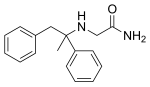
Remacemide is also known as remacemide hydrochloride, (±)-2-amino-N-(1-methyl-1,2-diphenylethyl)-acetamide hydrochloride, or FPL 12924AA.[7]

Other names(±)-2-amino-N-[1,2-di(phenyl)propan-2-yl]acetamide PR 934-423

Remacemide.svg

Drug interactions[edit]

Levodopa[edit]

Remacemide delays the absorption of levodopa (300 mg of remacemide one hour before levodopa treatment delays mean time to peak levodopa plasma concentration by 20%) but not its total absorption (area-under-the-curve for levodopa plasma concentration was unchanged).[18]

Sodium valproate[edit]

Remacemide does not interact with sodium valproate, a treatment for epilepsy.[19]

Carbamazepine[edit]

Ramacemide does interact with carbamazepine. Remacemide inhibits the metabolism of carbamazepine, while carbamazepine induces the metabolism of remacemide and FPL 12495.[20]

Remacemide salts[edit]

Remacemide is most commonly synthesized as the salt remacemide hydrochloride. However, there has been some investigation into other remacemide salts and their crystals, as different remacemide salts might taste more pleasant or have a solubility more suitable for a pediatric suspension formulation.[21]

Mechanism of action[edit]

Remacemide binds weakly and noncompetitively to the ionic channel site of the NMDA receptor complex.[7] Remacemide binds both allosterically and in the channel.[22] However, because remacemide binds so weakly to NMDAR, much of remacemide's in vivoeffect against excitotoxicity is thought to be caused by its metabolic transformation to the more potent desglycine derivative FPL 12495.[7] That is, remacemide may actually act as a prodrug to deliver the active metabolite FPL 12495 to the central nervous system.[23]

Epilepsy[edit]

In a well validated and described genetic model of absence epilepsy, rats of the WAG/Rij strain, remacemide and its metabolite FPL 12495 were found to have a common for glutamate antagonist usual effect on the number of spike/wave dischargesEEG, the drugs decrease spike/wave dischanges dose dependently. However, in contrast to most other glutamate antagonists, FPL 12495 increased the duration of the spike-wave discharges.[24]

FPL 12495[edit]

Much of remacemide's effect in vivo is thought to be caused by the desglycine derivative FPL 12495 (±).[7] FPL 12495 (±) binds specifically and non-competitively to NMDAR.[28] Its effect on maximal electroconvulsive shock is more potent than remacemide.[7]The S isomer (FPL 12859) is even more potent than the racemic mixture, while the R isomer is less potent than the racemate.[7]

FPL 12495 is sometimes referred to as ARL 12495AA.[29][30][31]

Other metabolites[edit]

FPL 15053[edit]

FPL 15053 is the N-hydroxy-desglycinate of remacemide, and exhibits modest binding to NMDAR and modest effects on convulsions and mortality in test mice and rats.[7]

FPL 14331 and FPL 14465[edit]

FPL 14331 and FPL 14465 are the p-hydroxy-desglycinates of remacemide, and they exhibit some efficacy against maximal electroconvulsive shock after i.p. and i.v. dosing.[7]

FPL 15455[edit]

FPL 15455 is an oxoacetate metabolite of remacemide, but has no demonstrated biological activity.[7]

FPL 14991 and FPL 14981[edit]

FPL 14991 and FPL 14981 are both Î²-Miydroxy-desglycinates of remacemide, and they display modest efficacy against maximal electroconvulsive shock in mice.[7] However FPL 14981 and not FPL 14991 prevents NMDLA-induced convulsions and mortality in mice.[7]

FPL 13592 and FPL 15112[edit]

The hydroxy-methyl derivative of remacemide (FPL 13592) and its desglycinate (FPL 15112) prevents electric shock-induced convulsions only after i.v. administration; only the desglycine derivative binds to NMDAR.[7]

FPL 14467[edit]

FPL 14467 (p-dihydroxy-desglycine) is inactive in vivo and weak in binding NMDAR.[7]

Pharmacodynamics[edit]

The values for 50% displacement of [3H]MK801 were 68 μM for remacemide and 0.48 μM for FPL 12495AA.[7]

Because of remacemide's potential as a neuroprotective agent through preventing glutamate toxicity, it was soon also under investigation as a treatment for Huntington's disease[39] and Parkinson's disease.[40]

https://en.wikipedia.org/wiki/Remacemide


09-06-2021-0108 - 2445/6-7,8

 09-06-2021-0108 - 2445/6-7,8

09-06-2021-0107 - hexapradol INN


Hexapradol (INN) is a psychostimulant drug which was never marketed.[1]

It also had cytoprotective/antiulcer properties.[2]

https://en.wikipedia.org/wiki/Hexapradol


09-06-2021-0106 - Diphenidine (1,2-DEP, DPD, DND)

 Diphenidine (1,2-DEP, DPD, DND) is a dissociative anesthetic that has been sold as a designer drug.[1][2][3] The synthesis of diphenidine was first reported in 1924, and employed a Bruylants reaction analogous to the one that would later be used to discover phencyclidine in 1956.[1] Shortly after the 2013 UK ban on arylcyclohexylamines, diphenidine and the related compound methoxphenidinebecame available on the grey market.[1] Anecdotal reports describe high doses of diphenidine producing "bizarre somatosensory phenomena and transient anterograde amnesia."[1] Diphenidine and related diarylethylamines have been studied in vitro as treatments for neurotoxic injury and are antagonists of the NMDA receptor.[4][5][6][7][8]In dogs diphenidine exhibits greater antitussive potency than codeine phosphate.[9][10]

Electrophysiological analysis demonstrates that the amplitude of NMDA-mediated fEPSPs are reduced by diphenidine and ketamine to a similar extent, with diphenidine displaying a slower onset of antagonism.[6] The two enantiomers of diphenidine differ greatly in their ability to block the NMDA receptor, with the more potent (S)-enantiomer possessing affinity forty times higher than the (R)-enantiomer.[5] Since diphenidine's introduction in 2013 vendors have stated the drug "acts on dopamine transport" yet no data concerning the action of diphenidine on the dopamine transporter was published until 2016.[1] Diphenidine's highest affinity is for the NMDA receptor, but it does display submicromolar affinity for the Ïƒ1 receptor, Ïƒ2 receptor and dopamine transporter.[11][12]

Since 2014 there have been several published reports of diphenidine being sold in combination with other research chemicals, particularly synthetic cannabinoids and stimulants in Japanese herbal incense blends.[13][14][15] The first reported seizure concerned a Japanese product called "fragrance powder" containing diphenidine and benzylpiperazine.[16] A herbal incense sold in the Shizuoka Prefecture under the name "Aladdin Spacial [sic] Edition" was found to contain diphenidine and 5F-AB-PINACA at concentrations of 289 mg/g and 55.5 mg/g, respectively.[13] A product called ‘‘Herbal Incense. The Super Lemon’’ containing AB-CHMINACA, 5F-AMB, and diphenidine was implicated in a fatal poisoning.[14] Most recently diphenidine consumed in conjunction with three substituted cathinones, three benzodiazepines, and alcohol was implicated in a fatal ingestion of "bath salt" and "liquid aroma" products in Japan.[17]

In Canada, MT-45 and its analogues were made Schedule I controlled substances.[18] Possession without legal authority can result in maximum seven years imprisonment. Further, Health Canada amended the Food and Drug Regulations in May, 2016 to classify DND as a restricted drug. Only those with a law enforcement agency, person with an exemption permit or institutions with Minister's authorization may possess the drug.


Diphenidine.svgLegal statusLegal status

Identifiers

CAS Number


https://en.wikipedia.org/wiki/Diphenidine

Saltwater - Chicane


090620210104

Missy Elliott - One Minute Man (feat. Ludacris) [Official Music Video]


090620210056

09-06-2021-0054 - Thirteen Service Members Dead Gradient

 https://www.clickorlando.com/news/local/2021/09/04/in-their-memory-oviedo-community-march-honors-13-us-service-members-killed-in-kabul-attack/


These are the US service members killed in the Kabul airport attack | Fox  News


At least 182 people were killed during the attack, including 169 Afghan civilians and 13 US service members. Two of the killed civilians were British dual-nationals and one was the child of a British national.[3][43] It was initially reported that 28 Taliban fighters had also been killed in the attack, but this was later denied by Taliban spokesman Zabiullah Mujahid in an interview with Radio Free Europe/Radio Liberty.[44] The dead Americans were identified as eleven Marines, one soldier, and one Navy corpsman.[5][13][45][46] The American deaths were the first US service deaths in Afghanistan since February 2020 and were the largest single loss of life of US military personnel since the 2011 Afghanistan Boeing Chinook shootdown.[47]

At least 150 more people were injured,[4] including 18 US military personnel and a number of Taliban members.[48]


09-06-2021-0033 - Post-translational modification


Pages in category "Post-translational modification"

The following 117 pages are in this category, out of 117 total. This list may not reflect recent changes (learn more).

U


https://en.wikipedia.org/wiki/Category:Post-translational_modification