Blog Archive

Saturday, August 14, 2021

08-14-2021-1744 - Atomic Mirror

In physics, an atomic mirror is a device which reflects neutral atoms in the similar way as a conventional mirror reflects visible light. Atomic mirrors can be made of electric fields or magnetic fields,[1] electromagnetic waves[2] or just silicon wafer; in the last case, atoms are reflected by the attracting tails of the van der Waals attraction (see quantum reflection).[3][4][5] Such reflection is efficient when the normal component of the wavenumber of the atoms is small or comparable to the effective depth of the attraction potential (roughly, the distance at which the potential becomes comparable to the kinetic energy of the atom). To reduce the normal component, most atomic mirrors are blazed at the grazing incidence

Ridged mirror. The wave with wavevector  is scattered at ridges separated by distance 

At grazing incidence, the efficiency of the quantum reflection can be enhanced by a surface covered with ridges (ridged mirror).[6][7][8][9]

The set of narrow ridges reduces the van der Waals attraction of atoms to the surfaces and enhances the reflection. Each ridge blocks part of the wavefront, causing Fresnel diffraction.[8]

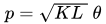
Such a mirror can be interpreted in terms of the Zeno effect.[7] We may assume that the atom is "absorbed" or "measured" at the ridges. Frequent measuring (narrowly spaced ridges) suppresses the transition of the particle to the half-space with absorbers, causing specular reflection. At large separation  between thin ridges, the reflectivity of the ridged mirror is determined by dimensionless momentum , and does not depend on the origin of the wave; therefore, it is suitable for reflection of atoms.
Applications[edit]

See also[edit]

References[edit]

  1. ^ H. Merimeche (2006). "Atomic beam focusing with a curved magnetic mirror". Journal of Physics B39 (18): 3723–3731. Bibcode:2006JPhB...39.3723Mdoi:10.1088/0953-4075/39/18/002.
  2. ^ V. I. Balykin & V. S. Letokhov (1988). "Quantum-State-Selective Mirror Reflection of Atoms by Laser Light". Physical Review Letters60 (21): 2137–2140. Bibcode:1988PhRvL..60.2137Bdoi:10.1103/PhysRevLett.60.2137PMID 10038269.
  3. ^ H. Friedrich; G. Jacoby, C. G. Meister (2002). "quantum reflection by Casimir–van der Waals potential tails". Physical Review A65 (3): 032902. Bibcode:2002PhRvA..65c2902Fdoi:10.1103/PhysRevA.65.032902.
  4. ^ F. Shimizu (2001). "Specular Reflection of Very Slow Metastable Neon Atoms from a Solid Surface". Physical Review Letters86 (6): 987–990. Bibcode:2001PhRvL..86..987Sdoi:10.1103/PhysRevLett.86.987PMID 11177991S2CID 34195829.
  5. ^ H. Oberst; Y. Tashiro; K. Shimizu; F. Shimizu (2005). "Quantum reflection of He* on silicon". Physical Review A71 (5): 052901. Bibcode:2005PhRvA..71e2901Odoi:10.1103/PhysRevA.71.052901.
  6. ^ F. Shimizu; J. Fujita (2002). "Giant Quantum Reflection of Neon Atoms from a Ridged Silicon Surface". Journal of the Physical Society of Japan71 (1): 5–8. arXiv:physics/0111115Bibcode:2002JPSJ...71....5Sdoi:10.1143/JPSJ.71.5.
  7. Jump up to: a b D. Kouznetsov; H. Oberst (2005). "Reflection of Waves from a Ridged Surface and the Zeno Effect". Optical Review12 (5): 1605–1623. Bibcode:2005OptRv..12..363Kdoi:10.1007/s10043-005-0363-9.
  8. Jump up to: a b H. Oberst; D. Kouznetsov; K. Shimizu; J. Fujita; F. Shimizu (2005). "Fresnel Diffraction Mirror for an Atomic Wave". Physical Review Letters94 (1): 013203. Bibcode:2005PhRvL..94a3203Odoi:10.1103/PhysRevLett.94.013203hdl:2241/104208PMID 15698079.
  9. ^ D. Kouznetsov; H. Oberst (2005). "Scattering of waves at ridged mirrors" (PDF)Physical Review A72 (1): 013617. Bibcode:2005PhRvA..72a3617Kdoi:10.1103/PhysRevA.72.013617.[permanent dead link]

Categories: 

 https://en.wikipedia.org/wiki/Atomic_mirror


08-14-2021-1743 - Particle-Beam Weapon

 A particle-beam weapon uses a high-energy beam of atomic or subatomic particles to damage the target by disrupting its atomic and/or molecularstructure. A particle-beam weapon is a type of directed-energy weapon, which directs energy in a particular and focused direction using particles with minuscule mass. Some particle-beam weapons have potential practical applications, e.g. as an antiballistic missile defense system for the United Statesand its cancelled Strategic Defense Initiative. They have been known by myriad names: phasers, disruptors, particle accelerator guns, ion cannons, proton beams, lightning rays, rayguns, etc.

The concept of particle-beam weapons comes from sound scientific principles and experiments currently underway around the world. One effective process to cause damage to or destroy a target is to simply overheat it until it is no longer operational. However, after decades of R&D, particle-beam weapons are still very much at the research stage and it remains to be seen if or when they will be deployed as practical, high-performance military weapons.

Particle accelerators are a well-developed technology used in scientific research for decades. They use electromagnetic fields to accelerate and direct charged particles along a predetermined path, and electrostatic "lenses" to focus these streams for collisions. The cathode ray tube in many twentieth-century televisions and computer monitors is a very simple type of particle accelerator. More powerful versions include synchrotrons and cyclotrons used in nuclear research. A particle-beam weapon is a weaponized version of this technology. It accelerates charged particles (in most cases electronspositronsprotons, or ionized atoms, but very advanced versions can accelerate other particles such as mercury nuclei) to near-light speed and then shoots them at a target. These particles have tremendous kinetic energy which they impart to matter in the target, inducing near-instantaneous and catastrophic superheating at the surface, and when penetrating deeper, ionization effects which can be especially detrimental to electronics in the target. However, high-power accelerators are extremely massive (sometimes in the order of kilometers, like the LHC), with highly constricted construction, operation and maintenance requirements, and thus unable to be weaponized using present or near-future technologies.

https://en.wikipedia.org/wiki/Particle-beam_weapon

08-14-2021-1743 - Plasma Acceleration

 Plasma acceleration is a technique for accelerating charged particles, such as electrons, positrons, and ions, using the electric field associated with electron plasma wave or other high-gradient plasma structures (like shock and sheath fields). The plasma acceleration structures are created either using ultra-short laser pulses or energetic particle beams that are matched to the plasma parameters. These techniques offer a way to build high performance particle accelerators of much smaller size than conventional devices. The basic concepts of plasma acceleration and its possibilities were originally conceived by Toshiki Tajima and John M. Dawson of UCLA in 1979.[1] The initial experimental designs for a "wakefield" accelerator were conceived at UCLA by Chandrashekhar J. Joshi et al.[2] Current experimental devices show accelerating gradients several orders of magnitude better than current particle accelerators over very short distances, and about one order of magnitude better (1 GeV/m[3] vs 0.1 GeV/m for an RF accelerator[4]) at the one meter scale.

Plasma accelerators have immense promise for innovation of affordable and compact accelerators for various applications ranging from high energy physics to medical and industrial applications. Medical applications include betatron and free-electron light sources for diagnostics or radiation therapyand protons sources for hadron therapy. Plasma accelerators generally use wakefields generated by plasma density waves. However, plasma accelerators can operate in many different regimes depending upon the characteristics of the plasmas used.

For example, an experimental laser plasma accelerator at Lawrence Berkeley National Laboratory accelerates electrons to 1 GeV over about 3.3 cm (5.4x10²⁰ gn),[5] and one conventional accelerator (highest electron energy accelerator) at SLAC requires 64 m to reach the same energy. Similarly, using plasmas an energy gain of more than 40 GeV was achieved using the SLAC SLC beam (42 GeV) in just 85 cm using a plasma wakefield accelerator (8.9x10²⁰ gn).[6] Once fully developed, the technology could replace many of the traditional RF accelerators currently found in particle colliders, hospitals, and research facilities.

Finally, the plasma acceleration would not be complete if the ion acceleration during the expansion of a plasma into a vacuum were not also mentioned. This process occurs, for example, in the intense laser-solid target interaction and is often referred to as the target normal sheath acceleration. Responsible for the spiky, fast ion front of the expanding plasma is an ion wave breaking process that takes place in the initial phase of the evolution and is described by the Sack-Schamel equation.[7]

https://en.wikipedia.org/wiki/Plasma_acceleration

08-14-2021-1743 - Superconducting radio frequency (SRF)

 Superconducting radio frequency (SRF) science and technology involves the application of electrical superconductors to radio frequency devices. The ultra-low electrical resistivity of a superconducting material allows an RF resonator to obtain an extremely high quality factorQ. For example, it is commonplace for a 1.3 GHz niobium SRF resonant cavity at 1.8 kelvins to obtain a quality factor of Q=5×10¹⁰. Such a very high Q resonator stores energy with very low loss and narrow bandwidth. These properties can be exploited for a variety of applications, including the construction of high-performance particle accelerator structures.

https://en.wikipedia.org/wiki/Superconducting_radio_frequency

08-14-2021-1740 - Particle Beam

 particle beam is a stream of charged or neutral particles. In particle-accelerators these particles can move with a velocity close to the speed of light. There is a difference between the creation and control of charged particle beams and neutral particle beams, as only the first type can be manipulated to a sufficient extent by devices based on electromagnetism. The manipulation and diagnostics of charged particle beams at high kinetic energies using particle accelerators are main topics of accelerator physics.

Charged particles such as electronspositrons, and protons may be separated from their common surrounding. This can be accomplished by e.g. thermionic emission or arc discharge. The following devices are commonly used as sources for particle beams:

Guidance[edit]

In all cases, the beam is steered with dipole magnets and focused with quadrupole magnets. With the end goal of reaching the desired position and beam spot size in the experiment.

Applications[edit]

High-energy physics[edit]

High-energy particle beams are used for particle physics experiments in large facilities; the most common examples being the Large Hadron Colliderand the Tevatron.

Synchrotron radiation[edit]

Electron beams are employed in synchrotron light sources to produce electromagnetic radiation with a continuous spectrum over a wide frequency band which is called synchrotron radiation. This radiation may be used at beamlines of the synchrotron storage ring for a variety of experiments.

Particle therapy[edit]

Energetic particle beams consisting of protonsneutrons, or positive ions (also called particle microbeams) may also be used for cancer treatment in particle therapy.

Astrophysics[edit]

Many phenomena in astrophysics are attributed to particle beams of various kinds. Perhaps of these the most iconic is the solar Type III radio burst, due to a mildly relativistic electron beam.

Military[edit]

Though particle beams are perhaps most famously employed as directed-energy weapon systems in science fiction, the U.S. Advanced Research Projects Agency started work on particle beam weapons in 1958.[3] The general idea of such weaponry is to hit a target object with a stream of accelerated particles with high kinetic energy, which is then transferred to the molecules of the target. The power needed to project a high-powered beam of this kind surpasses the production capabilities of any standard battlefield powerplant,[3] thus such weapons are not anticipated to be produced in the foreseeable future.

Mars colonization[edit]

Proton beams such as "laser-generated proton beams"[4] may be used as a way to generate hydrogen for the production of water on planets, such as Mars, where hydrogen is scarce and oxygen is relatively rich in the atmosphere in the form of CO2. In a Mars economy where the initial cost of water would be very high due to expense of transport from Earth to Mars, a machine that can generate hydrogen using nuclear alchemy, i.e., conversion of titanium into hydrogen ions using petawatt lasers, for example, is economical and may actually be cheaper and faster than transporting water from Earth to Mars if the technology is fully developed.[5]

See also[edit]

References[edit]

  1. ^ T. J. Kauppila et al. (1987), A pulsed electron injector using a metal photocathode irradiated by an excimer laser, Proceedings of Particle Accelerator Conference 1987
  2. ^ Petawatt proton beams at Lawrence Livermore
  3. Jump up to: a b Roberds, Richard M. (1984). "Introducing the Particle-Beam Weapon"Air University Review. July–August. Archived from the original on 2012-04-17. Retrieved 2005-01-03.
  4. ^ Petawatt proton beams at Lawrence Livermore
  5. ^ Multi-planetary Society, Vol. 23, spring 2018

https://en.wikipedia.org/wiki/Particle_beam