Blog Archive

Wednesday, September 29, 2021

09-28-2021-2048 - Iron oxide nanoparticles

Iron oxide nanoparticles are iron oxide particles with diameters between about 1 and 100 nanometers. The two main forms are magnetite (Fe3O4) and its oxidized form maghemite (γ-Fe2O3). They have attracted extensive interest due to their superparamagnetic properties and their potential applications in many fields (although Co and Ni are also highly magnetic materials, they are toxic and easily oxidized).

Applications of iron oxide nanoparticles include terabit magnetic storage devices, catalysissensorssuperparamagnetic relaxometry, high-sensitivity biomolecular magnetic resonance imagingmagnetic particle imagingmagnetic fluid hyperthermia, separation of biomolecules, and targeted drug and gene delivery for medical diagnosis and therapeutics. These applications require coating of the nanoparticles by agents such as long-chain fatty acidsalkyl-substituted amines, and diols.[citation needed] They have been used in formulations for supplementation.[1]

https://en.wikipedia.org/wiki/Iron_oxide_nanoparticle


Magnetic nanoparticles are a class of nanoparticle that can be manipulated using magnetic fields. Such particles commonly consist of two components, a magnetic material, often ironnickel and cobalt, and a chemical component that has functionality. While nanoparticles are smaller than 1 micrometer in diameter (typically 1–100 nanometers), the larger microbeads are 0.5–500 micrometer in diameter. Magnetic nanoparticle clusters that are composed of a number of individual magnetic nanoparticles are known as magnetic nanobeads with a diameter of 50–200 nanometers.[1][2]Magnetic nanoparticle clusters are a basis for their further magnetic assembly into magnetic nanochains.[3] The magnetic nanoparticles have been the focus of much research recently because they possess attractive properties which could see potential use in catalysis including nanomaterial-based catalysts,[4] biomedicine[5] and tissue specific targeting,[6] magnetically tunable colloidal photonic crystals,[7] microfluidics,[8] magnetic resonance imaging,[9] magnetic particle imaging,[10] data storage,[11][12] environmental remediation,[13] nanofluids,[14][15] optical filters,[16] defect sensor,[17]magnetic cooling[18][19] and cation sensors.[20]

https://en.wikipedia.org/wiki/Magnetic_nanoparticles

Disco Ball Stock Photo - Download Image Now - iStock

09-28-2021-2046 - 4376/7-8,9

 09-28-2021-2046 - 4376/7-8,9


black lungs matter.

Disco Ball Spotlight - PL1000

09-28-2021-2045 - crystal momentum


Crystal momentum[edit]

k-vectors exceeding the first Brillouin zone (red) do not carry any more information than their counterparts (black) in the first Brillouin zone.

By analogy to photons and matter waves, phonons have been treated with wavevector k as though it has a momentum Ä§k,[12] however, this is not strictly correct, because Ä§k is not actually a physical momentum; it is called the crystal momentum or pseudomomentum. This is because k is only determined up to addition of constant vectors (the reciprocal lattice vectors and integer multiples thereof). For example, in the one-dimensional model, the normal coordinates Q and Î  are defined so that

where

for any integer n. A phonon with wavenumber k is thus equivalent to an infinite family of phonons with wavenumbers k ± 2Ï€/ak ± 4Ï€/a, and so forth. Physically, the reciprocal lattice vectors act as additional chunks of momentum which the lattice can impart to the phonon. Bloch electrons obey a similar set of restrictions.

Brillouin zones, (a) in a square lattice, and (b) in a hexagonal lattice

It is usually convenient to consider phonon wavevectors k which have the smallest magnitude |k| in their "family". The set of all such wavevectors defines the first Brillouin zone. Additional Brillouin zones may be defined as copies of the first zone, shifted by some reciprocal lattice vector.


https://en.wikipedia.org/wiki/Phonon#Crystal_momentum


You Should Add A Disco Ball To Your DJ Lighting Rig In 2021


Mini Disco Ball Pinata Decoration 7 1/2in x 5in | Party City


09-28-2021-2045 - Quantum spin tunneling

24" Silver Disco Mirror Ball - Large Disco Ball with Hanging Swivel Ring |  eFavorMart

Quantum spin tunneling, or quantum tunneling of magnetization, is a physical phenomenon by which the quantum mechanical state that describes the collective magnetization of a nanomagnet is a linear superposition of two states with well defined and opposite magnetization. Classically, the magnetic anisotropy favors neither of the two states with opposite magnetization, so that the system has two equivalent ground states.

Because of the quantum spin tunneling, an energy splitting between the bonding and anti-bonding linear combination of states with opposite magnetization classical ground states arises, giving rise to a unique ground state[1] separated by the first excited state by an energy difference known as quantum spin tunneling splitting. The quantum spin tunneling splitting also occurs for pairs of excited states with opposite magnetization.

As a consequence of quantum spin tunneling, the magnetization of a system can switch between states with opposite magnetization that are separated by an energy barrier much larger than thermal energy. Thus, quantum spin tunneling provides a pathway to magnetization switching forbidden in classical physics.

Whereas quantum spin tunneling shares some properties with quantum tunneling in other  two level systems such as a single electron in a double quantum well or in a diatomic molecule, it is a multi-electron phenomenon, since more than one electron is required to have magnetic anisotropy. The multi-electron character is also revealed by an important feature, absent in single-electron tunneling: zero field quantum spin tunneling splitting is only possible for integer spins, and is certainly absent for half-integer spins, as ensured by Kramers degeneracy theorem. In real systems containing Kramers ions, like crystalline samples of single ion magnets, the degeneracy of the ground states is frequently lifted through dipolar interactions with neighboring spins, and as such quantum spin tunneling is frequently observed even in the absence of an applied external field for these systems.[citation needed]

Initially discussed in the context of magnetization dynamics[2][3] of  magnetic nanoparticles, the concept was known as macroscopic quantum tunneling, a term that highlights both the difference with single electron tunneling and connects this phenomenon with other macroscopic quantum phenomena. In this sense, the problem of quantum spin tunneling lies in the boundary between the quantum and classical descriptions of reality.

Single spin Hamiltonian[edit]

A simple single spin Hamiltonian that describes quantum spin tunneling for a spin  is given by:

 [1]

where  D and E are parameters that determine the magnetic anisotropy, and   are spin matrices of dimension  . It is customary to take z as the easy axis so that D<0 and |D|>> E. For E=0, this Hamiltonian commutes with  , so that we can write the eigenvalues as , where  takes the 2S+1 values in the list (S, S-1, ...., -S)
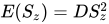
describes a set of doublets, with   and  . In the case of integer spins the second term of the Hamiltonian results in the splitting of the otherwise degenerate ground state doublet. In this case, the zero field  quantum spin tunneling splitting is given by:
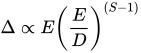
From this result, it is apparent that, given that E/D is much smaller than 1 by construction, the quantum spin tunnelling splitting becomes suppressed in the limit of large spin S, i.e., as we move from the atomic scale towards the macroscopic world. The magnitude of the quantum spin tunnelling splitting can be modulated by application of a magnetic field along the transverse hard axis direction (in the case of Hamiltonian [1], with D<0 and E>0, the x axis). The modulation of the quantum spin tunnelling splitting results in oscillations of its magnitude,[4] including specific values of the transverse field at which the splitting vanishes. This accidental degeneracies are known as diabolic points.

Observation of Quantum Spin Tunneling[edit]

Quantum tunneling of the magnetization was reported in 1996 for a crystal of Mn12ac molecules with S=10.[5] Quoting Thomas and coworkers,[5] "in an applied magnetic field, the magnetization shows hysteresis loops with a distinct 'staircase' structure: the steps occur at values of the applied field where the energies of different collective spin states of the manganese clusters coincide. At these special values of the field, relaxation from one spin state to another is enhanced above the thermally activated rate by the action of resonant quantum-mechanical tunneling". Quantum tunneling of the magnetization was reported in ferritin[6] present in horse spleen proteins[7]

direct measurement of the quantum spin tunneling splitting energy can be achieved using single spin scanning tunneling inelastic spectroscopy, that permits to measure the spin excitations of individual atoms on surfaces.[8] Using this technique, the spin excitation spectrum of an individual integer spin was obtained by Hirjibehedin et al.[9] for a S=2 single Fe atom on a surface of Cu2N/Cu(100), that made it possible to measure a quantum spin tunneling splitting of 0.2 meV. Using the same technique other groups measured the spin excitations of S=1 Fe phthalocyanine molecule on a copper surface[10] and a S=1 Fe atom on InSb,[11] both of which had a quantum spin tunneling splitting of the   doublet larger than 1 meV.

In the case of molecular magnets with large S and small E/D ratio,  indirect measurement techniques are required to infer the value of the quantum spin tunneling splitting. For instance, modeling time dependent magnetization measurements of a crystal of Fe8 molecular magnets with the Landau-Zener formula, Wernsdorfer and Sessoli [12] inferred tunneling splittings in the range of 10−7 Kelvin.


https://en.wikipedia.org/wiki/Quantum_spin_tunneling


16&quot; Mirror Disco Ball Silver - India&#39;s Premium Party Store - Wanna Party

09-28-2021-2043 - Jellium uniform electron gas UEG homogeneous electron gas (HEG)

 Jellium, also known as the uniform electron gas (UEG) or homogeneous electron gas (HEG), is a quantum mechanical model of interacting electrons in a solid where the positive charges (i.e. atomic nuclei) are assumed to be uniformly distributed in space; the electron density is a uniform quantity as well in space. This model allows one to focus on the effects in solids that occur due to the quantum nature of electrons and their mutual repulsive interactions (due to like charge) without explicit introduction of the atomic lattice and structure making up a real material. Jellium is often used in solid-state physics as a simple model of delocalized electrons in a metal, where it can qualitatively reproduce features of real metals such as screening, plasmons, Wigner crystallization and Friedel oscillations.

At zero temperature, the properties of jellium depend solely upon the constant electronic density. This lends it to a treatment within density functional theory; the formalism itself provides the basis for the local-density approximation to the exchange-correlation energy density functional.

The term jellium was coined by Conyers Herring, alluding to the "positive jelly" background, and the typical metallic behavior it displays.[1]

https://en.wikipedia.org/wiki/Jellium#Zero-temperature_phase_diagram_of_jellium_in_three_and_two_dimensions

Yescom 12 inch LED Mirror Disco Ball for sale online | eBay

09-28-2021-2040 - states that the lowest energy state has the highest spin angular momentum. For each of these complexes we can calculate a crystal field stabilization energy

 Introduction to Inorganic Chemistry/Coordination Chemistry and Crystal Field Theory

states that the lowest energy state has the highest spin angular momentum. For each of these complexes we can calculate a crystal field stabilization energy

https://en.wikipedia.org/w/index.php?title=Special:Search&limit=20&offset=20&ns0=1&search=ground+state+crystal+zero&searchToken=av73xv5rs67o8sj8sguq0bbbs

Lava® the Original Multi-colored Disco Ball - Walmart.com

09-28-2021-2039 - effective nuclear charge

disco fever. / sfgirlbybay

The effective nuclear charge (often symbolized as  or ) is the net positive charge experienced by an electron in a polyelectronic atom. The term "effective" is used because the shielding effect of negatively charged electrons prevent higher orbital electrons from experiencing the full nuclear charge of the nucleus due to the repelling effect of inner-layer electrons. The effective nuclear charge experienced by the electron is also called the core charge. It is possible to determine the strength of the nuclear charge by the oxidation number of the atom. Most of the physical and chemical properties of the elements can be explained on the basis of electronic configuration. Consider the behavior of ionization energies in the periodic table. It is known that the magnitude of ionization potential depends upon the following factors:

(a) Size of atom;

(b) The nuclear charge;

(c) The screening effect of the inner shells, and;

(d) The extent to which the outermost electron penetrates into the charge cloud set up by the inner lying electron.

In the periodic table,Effective nuclear charge(Zeff) increases both down the group and across a period.

https://en.wikipedia.org/wiki/Effective_nuclear_charge


Diamond dust is a ground-level cloud composed of tiny ice crystals. This meteorological phenomenon is also referred to simply as ice crystals and is reported in the METAR code as IC. Diamond dust generally forms under otherwise clear or nearly clear skies, so it is sometimes referred to as clear-sky precipitation. Diamond dust is most commonly observed in Antarctica and the Arctic, but can occur anywhere with a temperature well below freezing. In the polar regions of Earth, diamond dust may persist for several days without interruption.

https://en.wikipedia.org/wiki/Diamond_dust


Disco Ball - Mirror Ball - Party Time Rental | Denver &amp; Colorado Springs

09-28-2021-2039 - multiplicity energy level

Disco ball - Party Invitation Template (Free) | Greetings Island

 In spectroscopy and quantum chemistry, the multiplicity of an energy level is defined as 2S+1, where S is the total spin angular momentum.[1][2][3]States with multiplicity 1, 2, 3, 4, 5 are respectively called singlets, doublets, triplets, quartets and quintets.[2]

In the ground state of an atom or molecule, the unpaired electrons usually all have parallel spin. In this case the multiplicity is also equal to the number of unpaired electrons plus one.[4]

Atoms[edit]

The multiplicity is often equal to the number of possible orientations of the total spin[3] relative to the total orbital angular momentum L, and therefore to the number of near–degenerate levels that differ only in their spin–orbit interaction energy.

For example, the ground state of  carbon atom is a 3P state. The superscript three (read as triplet) indicates that the multiplicity 2S+1 = 3, so that the total spin S = 1. This spin is due to two unpaired electrons, as a result of Hund's rule which favors the single filling of degenerate orbitals. The triplet consists of three states with spin components +1, 0 and –1 along the direction of the total orbital angular momentum, which is also 1 as indicated by the letter P. The total angular momentum quantum number J can vary from L+S = 2 to L–S = 0 in integer steps, so that J = 2, 1 or 0.[1][2]

However the multiplicity equals the number of spin orientations only if S ≤ L. When S > L there are only 2L+1 orientations of total angular momentum possible, ranging from S+L to S-L.[2][3] The ground state of the nitrogen atom is a 4S state, for which 2S + 1 = 4 in a quartet state, S = 3/2 due to three unpaired electrons. For an S state, L = 0 so that J can only be 3/2 and there is only one level even though the multiplicity is 4.

Molecules[edit]

Most stable organic molecules have complete electron shells with no unpaired electrons and therefore have singlet ground states. This is true also for inorganic molecules containing only main-group elements. Important exceptions are dioxygen (O2) as well as methylene (CH2) and other carbenes.

However, higher spin ground states are very common in coordination complexes of transition metals. A simple explanation of the spin states of such complexes is provided by crystal field theory.

Dioxygen[edit]

The highest occupied orbital energy level of dioxygen is a pair of antibonding Ï€* orbitals. In the ground state of dioxygen, this energy level is occupied by two electrons of the same spin, as shown in the molecular orbital diagram. The molecule, therefore, has two unpaired electrons and is in a triplet state.

In contrast, the first and second excited states of dioxygen are both states of singlet oxygen. Each has two electrons of opposite spin in the Ï€* level so that S = 0 and the multiplicity is 2S + 1 = 1 in consequence.

In the first excited state, the two π* electrons are paired in the same orbital, so that there are no unpaired electrons. In the second excited state, however, the two π* electrons occupy different orbitals with opposite spin. Each is therefore an unpaired electron, but the total spin is zero and the multiplicity is 2S + 1 = 1 despite the two unpaired electrons. The multiplicity of the second excited state is therefore not equal to the number of its unpaired electrons plus one, and the rule which is usually true for ground states is invalid for this excited state.

Molecular orbital diagram of two singlet excited states and triplet ground state of O2. From left to right, the diagrams are for: 1Δg singlet oxygen (first excited state), 1Σ+
g
 singlet oxygen (second excited state), and 3Σ
g
 triplet oxygen (ground state).

Carbenes[edit]

In organic chemistrycarbenes are molecules which have carbon atoms with only have six valence electrons and therefore disobey the octet rule.[5]Carbenes generally split into singlet carbenes and triplet carbenes, named for their spin multiplicities. Both have two non-bonding electrons; in singlet carbenes these exist as a lone pair and have opposite spins so that there is no net spin, while in triplet carbenes these electrons have parallel spins.[6]

See also[edit]

https://en.wikipedia.org/wiki/Multiplicity_(chemistry)